
What a Dry Summer Revealed About Mushrooms
By Mark McLean
Mushrooms can appear from early spring through late fall, but August and September are typically when the greatest diversity of species is found in Muskoka’s forests.
The mushrooms we see emerging from the forest floor are the fruiting bodies of fungi that live underground. The unseen part of the organism consists of a vast network of thread-like structures called hyphae, collectively known as the mycelium. Most of these mushrooms are mycorrhizal, meaning their hyphae have formed a connection with the roots of plants including trees.
Through this connection, the fungus receives carbon produced by the plant through photosynthesis, while the plant gains access to essential nutrients such as phosphorus and nitrogen, which the fungus is able to break down and extract from the soil. This mutually beneficial exchange depends on one critical factor: water, which acts as the medium that allows nutrients to move between partners.
From July through October of 2025, Muskoka received only a fraction of its usual precipitation, combined with periods of unusually high temperatures. As a result, plants shifted into survival mode. While older trees can often endure short-term drought, younger trees may struggle.
Because mushrooms consist of up to 95% water, dry conditions dramatically reduce the ability of the fungus to form fruiting bodies. When water is scarce and plants stop sharing resources, fungi simply do not produce mushrooms.
These conditions were clearly reflected during the August mushroom forays in 2025. Compared to the previous two years, approximately 60% fewer mushroom species were observed—a striking illustration of how closely fungi are tied to moisture levels and forest health.
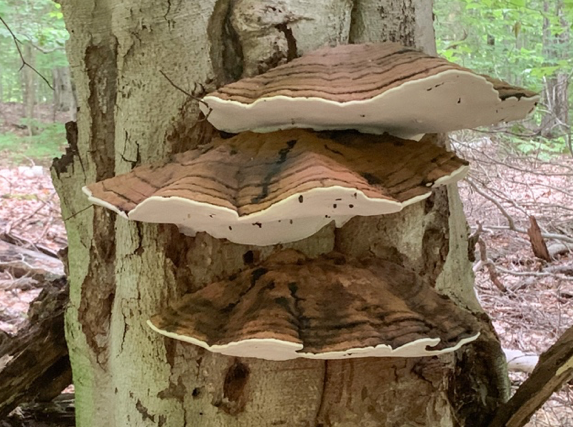
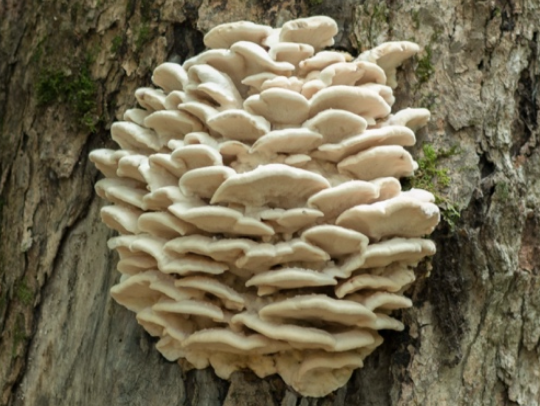
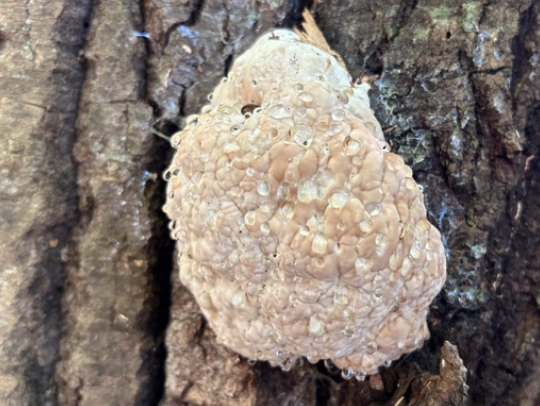
Most of the mushrooms that were found last year were growing on living or dead trees and most of those were polypores. Here are a few examples of polypore mushrooms.
Related Reading
Learn more about fungi, forest health, and climate science in these recent articles from The New York Times and The Guardian. Please note that some links may require a subscription to access in full.
Toby Kiers, World Champion of Fungus (The New York Times)
A profile of award-winning scientist Toby Kiers and her groundbreaking work on fungal networks and ecosystem health.
Read article
How Fungi Move Among Us (The New York Times)
An in-depth look at underground fungal networks and their role in regulating climate and ecosystems.
Read article
‘Nature’s Original Engineers’: Scientists Explore the Amazing Potential of Fungi (The Guardian)
Researchers examine how fungi could help address environmental and technological challenges.
Read article
Fungi Could Be Given Same Status as Flora and Fauna Under Conservation Plan (The Guardian)
An overview of international efforts to recognize fungi as essential to biodiversity conservation.
Read article